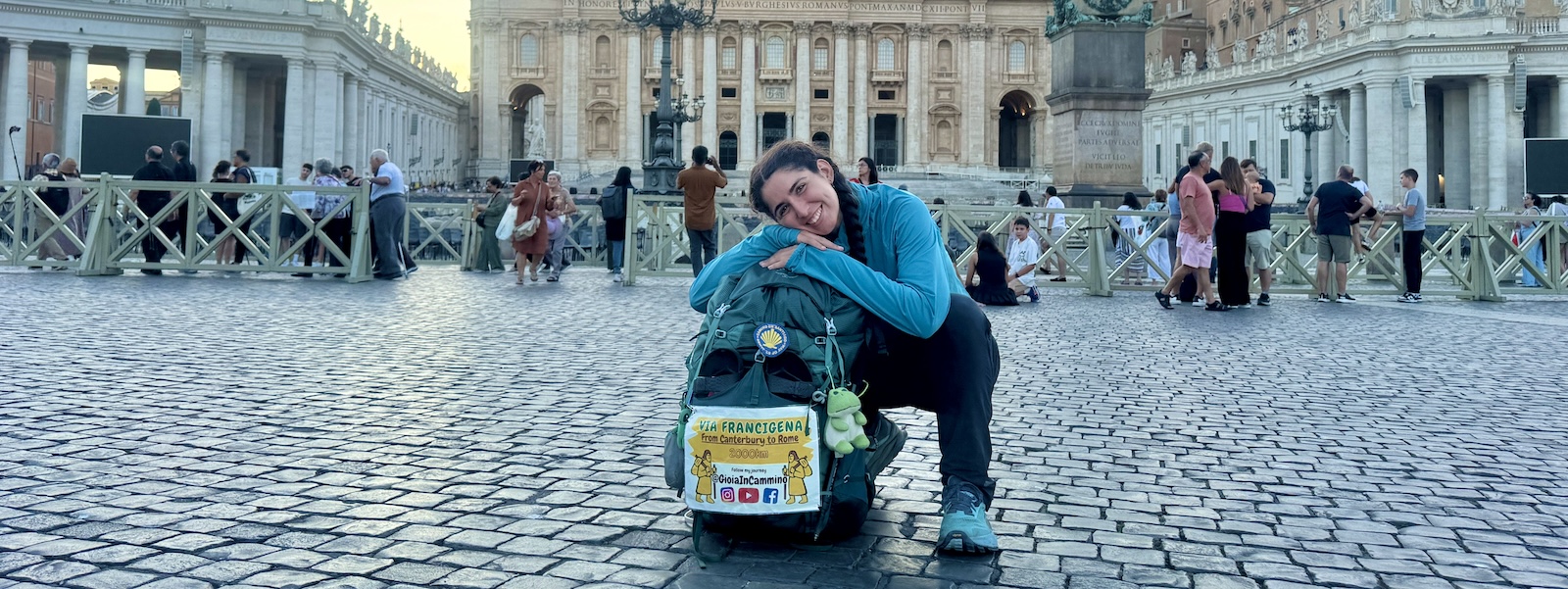
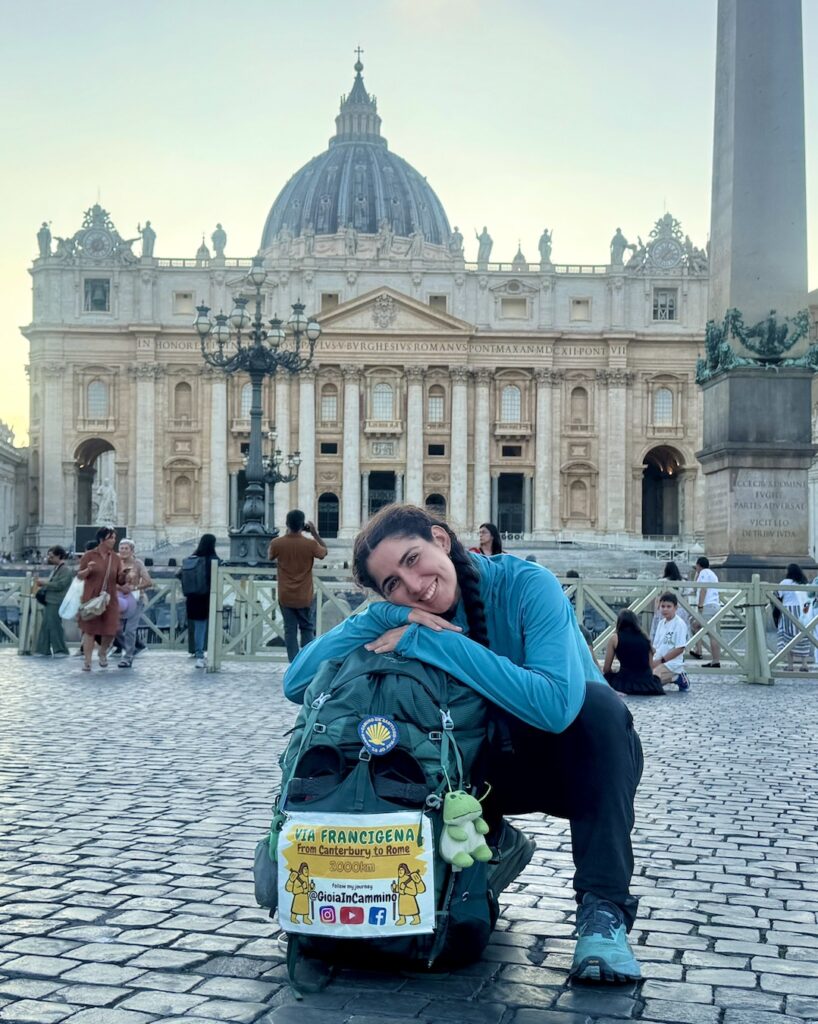

In every walk, especially the longest one you’ve ever been on, there comes a moment when you stop wondering if you’re going to make it and continue, simply, walking. Sometimes that moment comes when you tie your shoes, put on your backpack and take your first steps toward STAGE number one. Other times you first have to overcome the most difficult trials, which come to you one after another, until you no longer ask yourself that question without even realizing it.
For Gioia Castigliego, who in the summer of 2025 decided to walkthe Via FRANCIGENA from Canterbury to Rome without ever having attempted such a long undertaking before, that moment came after a lightning storm during the first night in the tent, a psychologically hard week, and unfortunate encounters that we would never want to happen. That moment for Gioia came when despite the difficulties she enthusiastically decided to continue a journey that lasted 95 days and over 2,000 km, crossing four different countries. Not bad for someone who, she admits, has always suffered from anxiety.
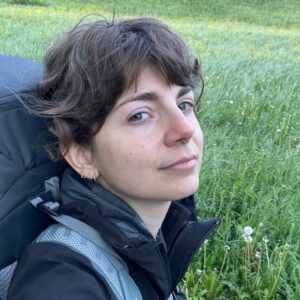
An environmental hiking guide born in Alghero in 1999, Gioia talks about her approach to walking and RV life on her YouTube channel and Instagram: a way of approaching nature far from the performativity that is increasingly easy to find online and that makes people want to feel freer and braver, even when there seem to be obstacles that society still wants to convince us are insurmountable.
The beginning of Gioia in Cammino, to the Via Francigena
Gioia describes her schooling as somewhat chaotic, and explains how only in retrospect did it make sense to her, starting with a great passion for languages and the Japanese world, particularly her paintings depicting nature. From Alghero, her hometown, she thus moved to Turin to study Languages and Cultures, and then to Venice for a Master’s Degree in Anthropology of Asia, where she specialized precisely in relational social practices between humans and nature in the context of Forest Therapy in Japan. “I rediscovered a lot of my approach to nature, which is slower than performative.”
The idea of becoming an Environmental Hiking Guide (EAG) came while she was graduating from college. “I hadn’t had so many experiences in nature before because I was insecure and suffered from anxiety, but I wanted to put myself out there, expand my theoretical and practical knowledge.” And the grandparents give her the best graduation gift possible: the course to become one!
Anxiety is a constant travel companion for Gioia, especially in 2021, when in her first year of university in Venice she goes through the end of an important relationship. But two years later, when she meets her current partner and tells him about her dream of walking the Camino de Santiago he spurs her on, and that summer Gioia completes what she remembers as “the most beautiful experience of my life,” truly transforming walking into something everyday. In 2024 she flew to Japan to do research, and completed two tented walks: one as a couple, the other, in the mountains, completely solo.
The fundamentals of a pathway
The first criterion for choosing a path, for Gioia, is to understand where it passes: “It doesn’t mean it has to be made of landscapes (for a month in France I saw only fields!), but I always ask myself if the path is laid out logically, or if it makes strange arcs.”
The walk should be an opportunity for knowledge and sharing. “Long or short, for me the important thing is that at some point it becomes social. I would not be able to do a walk totally in solitude, because for me it means sharing.”
A walk, then, must be “tent friendly.” “I must have the possibility of sleeping in a tent in case of emergency, thus not transiting through areas where I would be paranoid at night.” In case of long walks, he explains, it is often necessary to sleep in a tent also for economic reasons. The important thing is that there is the possibility of connections to the big cities at least occasionally, so that one can stock up on equipment, buy medicines, and so on.
And then there must be something new to tell. The idea of walking the Via FRANCIGENA was born before 2025, along with the desire to walk for several months, alone, and test herself, even taking her tent with her. She had heard about it from high school, but on YouTube “very few people had told about it starting in Canterbury. I would have liked it if someone had done it-so I did!”
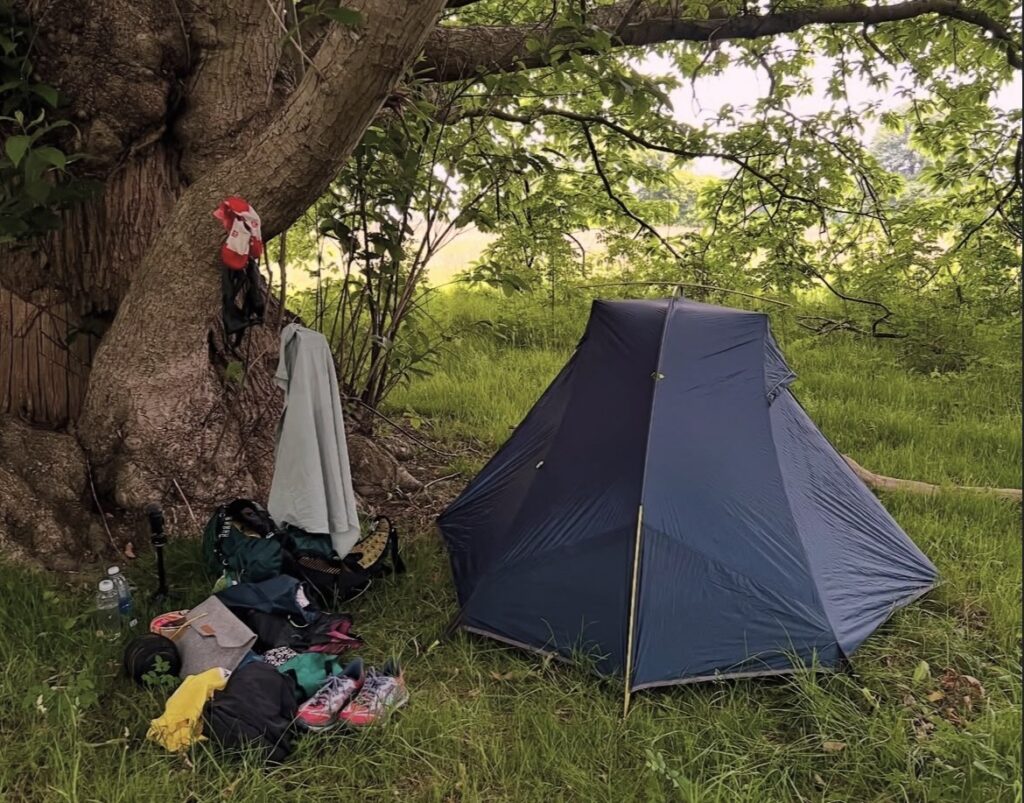
How the relationship with being on the road changes in the time of three months
Once back home in October, Gioia looked back at all the videos she posted on YouTube and realized that she had changed. “I left telling myself that I was going to last a week, that I wasn’t going to make it. I even confessed it on Instagram, and I had a cry that night because I was afraid I would fail.” Yet she has an incredible desire to walk, and she is “giddy” about all the encouragement she gathered during the Yunka Festival, the festival organized by Cammini d’Italia, just a few days before.
“The very first night I found the worst possible conditions: a lightning storm that forced me to flee and seek shelter. The first two or three days were literally a catastrophe, and the first week proved to be very difficult-it was something different from the Camino di Santiago or Japan. I was very tired, and not only had I not met any other pilgrims, but I had almost exclusively encountered problems.” Also adding to the challenge of the experience is the work Gioia does remotely, every afternoon, with her laptop computer weighing in her backpack.
Ahead of her, however, Gioia has all of Europe and continues on. With her spirits still high, however, she encounters another obstacle that she could never have expected: she is harassed by two men, who follow her in a car and then bar her way. Fortunately, among the dozens of drivers who pull straight without even wondering if everything is okay, a woman senses, stops and helps her. Gioia takes a couple of days off, addresses the incident on the phone with her psychologist, and gives herself time to figure out how she is doing.
He started walking again, once more, and after a week he met those who would be his walking companions from France onward. “Everything has improved.” By the third week, Gioia begins to laugh at setbacks with her new friends and finds a serenity she would not have imagined only a few weeks earlier.
Meetings on the path
How do you reconcile walking alone and doing it with company? “It depends. – she says, – there is a balance. Maybe the best thing is to walk with others, but solo. On the walk, when you set out alone, you know you will have your time, and that no one will be offended when you meet at the bar, at dinner, at the hostel. It is magic when you meet others and solitude becomes a free choice.”
But the others are not just the pilgrims, but the local communities and individual people who live in the places crossed, who can make a difference. “During the first night in England, I found an angel who took me in-and even the rest of the Via FRANCIGENA in France would not have been such without the people who live there. I remember everyone who helped me with water, sleep, including the migrant reception center that gave me a close-up look at a reality I had never observed. Despite that bad encounter, I made hundreds of good ones.”
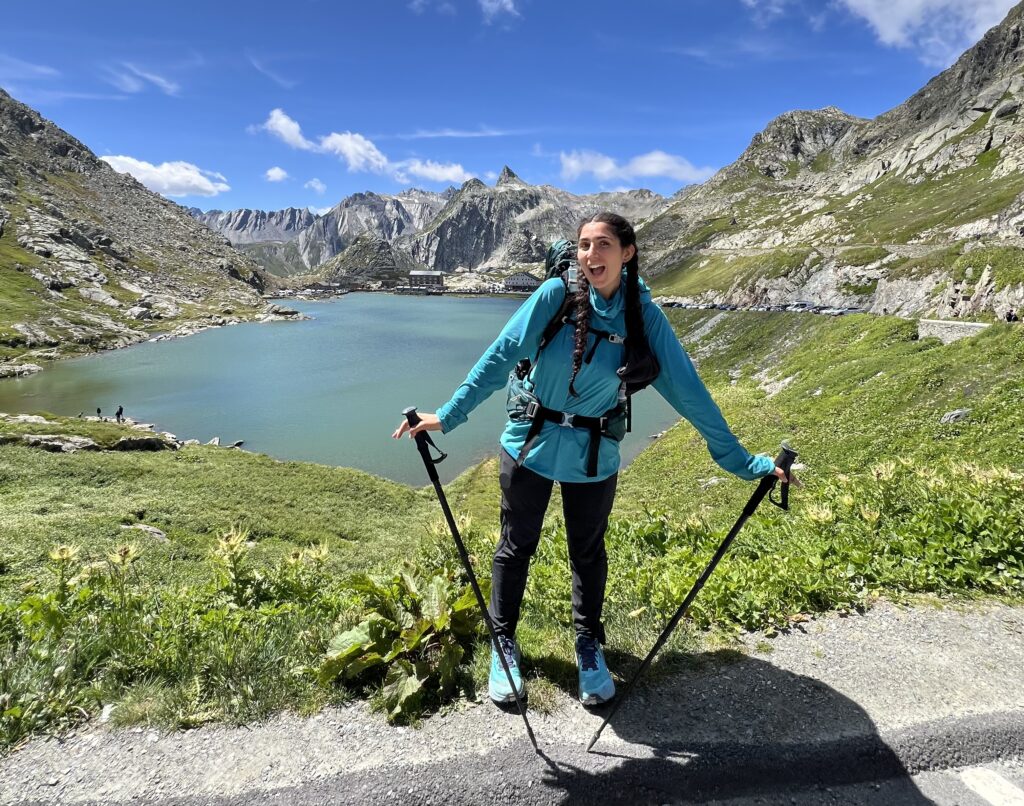
Switzerland passes quickly, in just ten days, in which Gioia sleeps mostly in tourist campsites. And then Italy, home. “It happened several times that I was helped by people at the bar when I could not find sleep, that I met parish hospitality that was already full, but always found a place. After the Po Valley, on the other hand, I found a lot of detachment, perhaps because there are much larger flows of pilgrims and there is less help from the community.
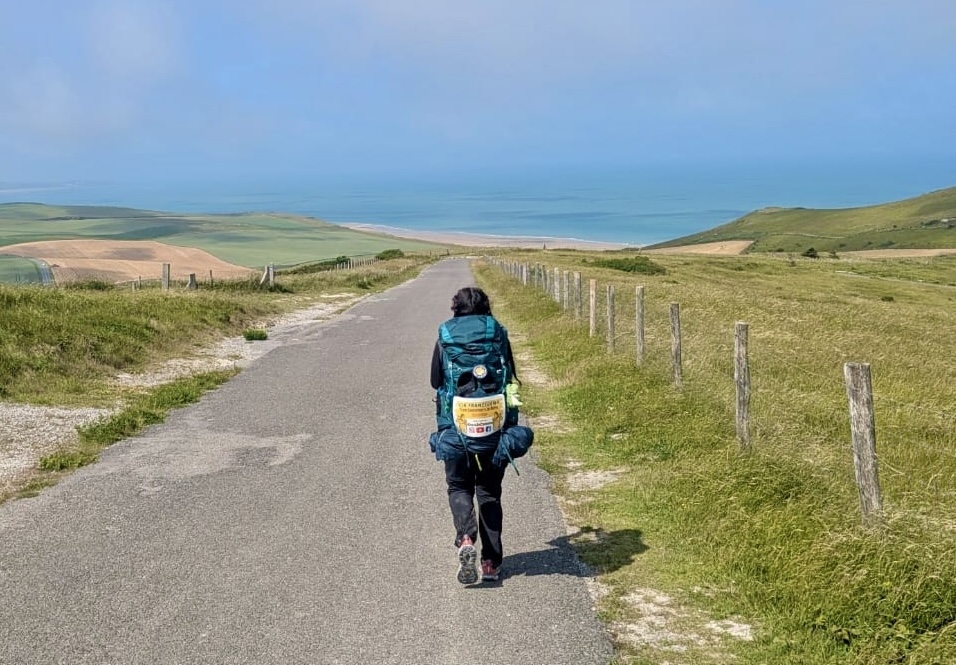
Being a woman walking in 2026
Walking as a woman “is one of the things that used to scare me, but like so many other situations in my everyday life,” she says. – When I went to live in Turin when I was 18, I used to return alone in the evenings on transportation. The issue is that harassment can happen anywhere: why should I restrict my freedom when there are no more or less safe situations? And I always tell myself that if I don’t do these things now, I will never do them again.”
Being a woman walking alone and telling it on social media, she says, “although it makes me more vulnerable to comments, it makes me really so happy when I receive messages from people telling me that I have transmitted the strength to do something that is not then more dangerous than going out and running around the house. I feel I have a great privilege at this moment in history, and I want to use it, reclaiming my space and my time.”
“I know you never really feel ready to leave, but it’s bad to limit your freedom. Just take a few precautions.” Joy, for example, never shares location in real time and I always published with a few days to spare. “I missed meetings with people who would host me, but I had to think about my safety first.”
The relationship with the body when making and returning from a walk
Before leaving for Canterbury Gioia is serene, at her ideal weight and full of energy, respecting her body and hoping it will accompany her for the best. “I always had a lot of problems with my body, because of the bullying I suffered. But then I started to love it again, and even then I got closer to the right weight.”
After a month of daily walking, the body claims food. “I was eating 3500 calories a day and not taking an ounce: I was doing 28 km a day and carrying 12 kilos of backpack. I felt beautiful and strong!” Upon returning home, however, Gioia went from walking for hours on end to moving much less, while her appetite remained the same. “Your stomach and brain don’t understand that you are no longer walking-I had a very hard time dealing with it and now I am following a more balanced eating plan while doing more sports. Although I have gained back pounds that I would have hated in the past, now I look at myself and think that my body is beautiful, capable of doing great things.”
The body, for Gioia, is now no longer a number, but a way of feeling and being in motion. It is not a figurine, as women often are; it is not made for pleasure, but for living and experiencing. “Reentry is always difficult, but there remains that feeling of being a machine that can do beautiful things. It would be nice to talk about it more, it’s a zero point for the next adventure!”
The next adventure, for now, Gioia does not want to spoil it. “I’m planning it. It will be something longer and more difficult, but I will stay in Europe, because there is still so much to see. I want to put my loneliness on the line a bit more and especially sleep in a tent!”
If this article has intrigued you, don’t miss Gioia in Cammino ‘s talk at Fa’ la cosa giusta! (March 13-14-15 at Rho Fiera), in the space of Cammini d’Italia.